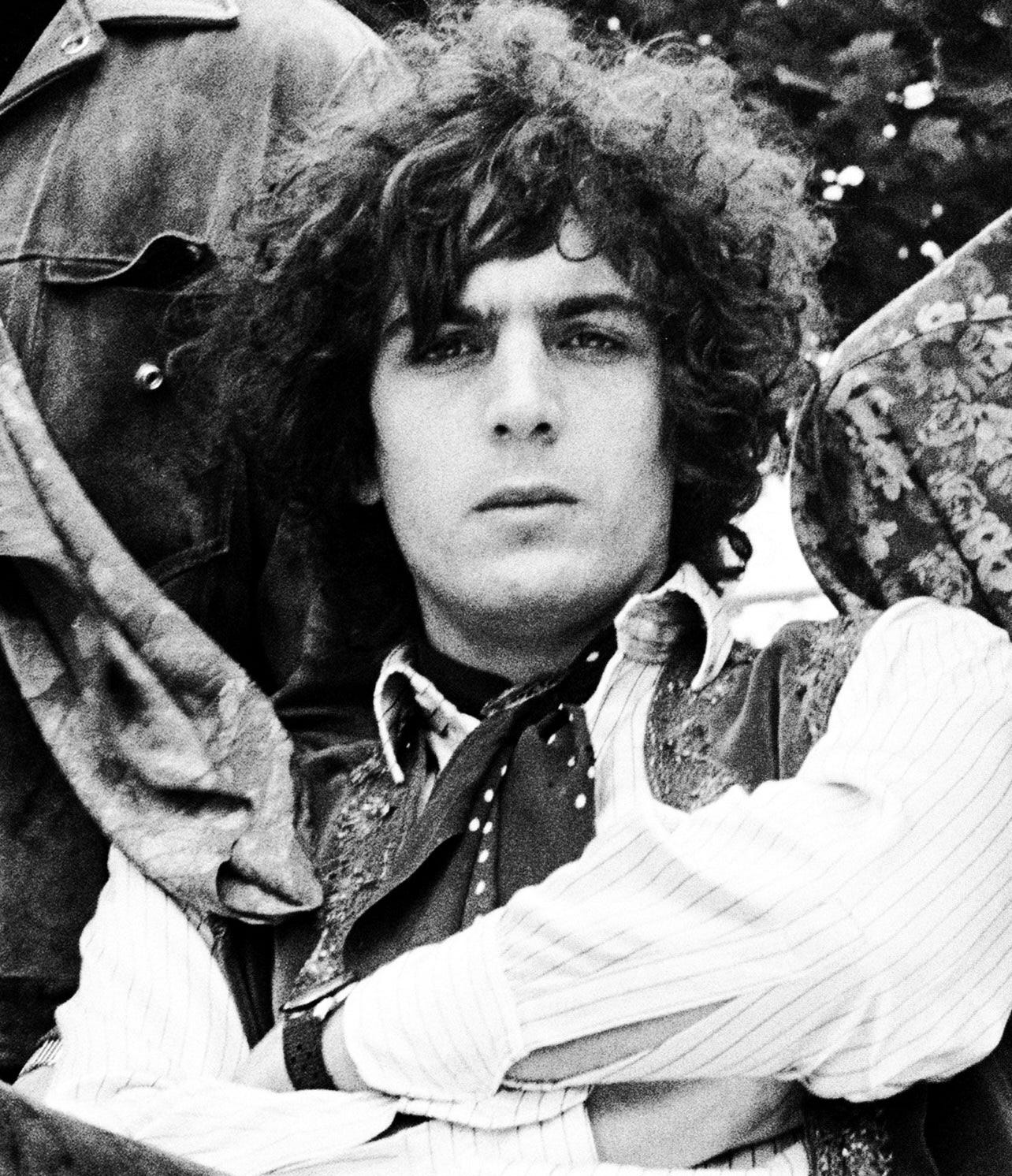
Syd
The Piper At The Gates Of Dawn

For this week's excerpt we travel all the way back to 1967, and Pink Floyd’s debut album. This piece is the opening of Chapter 1. The book should be out next week, after a short delay.
For decades, The Piper At The Gates Of Dawn has occupied a space in my Top 10 Albums Of All Time list, only to vacate it if The Dark Side Of The Moon happens to stride in. I first heard it at school in the latter half of the 1970s, and recognised that it was somehow different from the Pink Floyd LPs I was more familiar with – the progressive group with awesome concepts. Yet, being so naïve and knowing little about music, I could not put my finger on why it sounded different. I just knew that it did, and I liked that differentness.
Now I know that this all-time great debut album is the sole Floydian child of Syd Barrett, who wrote almost every song and who in those early days was considered the group’s presiding genius. And he was. But why? Who was this revered, remarkable man?
In a work about the group’s albums, it is best perhaps to approach Barrett through his songs. Those songs exhibit a quality rare even then, almost sixty years ago, when quality melodies were two-a-penny and many bands had a presiding genius. How different from the pop music of today. Two gifts made Barrett stand out: his gift for melody and his gift for wordplay.
There are songwriters who have an instinctive flair for melody, and that gift often makes their work distinctive. For a few, whose gifts are so prodigious they dwarf even those of Syd Barrett, there are almost no peers – I think of Paul McCartney, Paul Simon, Burt Bacharach. Although Barrett was no Mozart, as is McCartney, he was quite the most extraordinary writer of melody, whose instinctive gift allowed him to pen melodies that rose and fell along half-unknown scales that even Macca would at first be baffled by. Only Barrett could write the tune to The Scarecrow, for instance, or his oft-quoted miracle of melody, Bike. Where melody comes from is a littleexplored conundrum, but in Barrett’s case, it came from some combination of his mind – perhaps his links to his own childhood and the nursery rhymes which resided there – and his musicality. His use of melody was part of his vehicle of communication, which also included the lyrics and the mood of his songs. Those moods, following psychedelic paths, ranged from whimsical through strange, all the way to profound. Yet even the profound songs were set in a landscape that owed a lot to the aura of childhood.
For Barrett, children’s books were entrancing; not just an escape, but an evocation of a time in his life that he wished to re-experience when he was older. But that entrancing aura was not just about the delights of childhood, it was about the English landscape too. Barrett felt an instinctive union with the world of Kenneth Graham’s The Wind In The Willows, which has a chapter in it entitled ‘Piper At The Gates Of Dawn.’ That chapter is an evocation of Ratty and Mole finding their pagan lord Pan, whose demesne in this book is the classic English landscape. The adventures of Ratty, Mole, Badger and Toad of Toad Hall spoke to Barrett in a way so many British readers of that wonderful book recognise; its love of nature, its descriptions of river and woods, its narrative simplicity, its evocation of an England yet to be harrowed by the many hells of the First World War. The golden light of summer illuminated Barrett’s mind as he wrote songs about scarecrows and gnomes. Indeed, in the latter case, he was influenced by another children’s classic, The Little Grey Men by ‘BB.’ This author was in fact the illustrator of the book, Denys Watkins-Pitchford, a man also in love with the English landscape.
The Little Grey Men is a delightful book – one of Barrett’s favourites. In it, three gnomes living in the hollowed-out bottom of a tree decide to journey upriver in search of their missing friend. The book is filled with lovingly crafted descriptions of the English landscape, including elements that would be recognised by such painters as John Constable. The three gnomes have to survive off the land, fishing, hiding from big folk like you and me (no gnome must ever be seen by a human being), and distilling country wine – a task mentioned by Barrett in one of his songs. As an evocation of an English landscape now largely lost, it is hard to beat, and in many respects is not a children’s book at all, except in that children can enjoy it just as much as adults. Perhaps adults grasp more of the context and deeper meaning. But none of the beautiful simplicities of this classic novel would have been lost on Barrett, least of all the uncomplicated, emotionally satisfying task of surviving without the need to do a 9-5 job, to be dependent on others, or to leave and lose a radiantly beautiful landscape. The worldview of both children’s novels suffuses the album that Barrett and his three bandmates recorded. There were other influences, of course, including psychedelia and space travel, but that child’s perspective and that love of nature and landscape were at least as important.
Other influences were Hilaire Belloc and Edward Lear. Lear in particular tapped into that same, very English sense of humour that is both playful and absurdist, which Barrett also mined. For Lear, the emphasis was on happy nonsense, with plenty of imaginary creatures and individuals. There existed an eccentric English world of playing with language for its own sake – an almost musical play, with its emphasis on internal rhyming and alliteration – but which also had a kind of eccentric natural thinking, taking the oddness of English life and viewing the rural or natural lifestyle in particular through that lens. Much of this was down to the strict hierarchies manifesting in England as the class system. It is from this harsh social reality that the absurdist side of English humour comes, a humour attractive to John Lennon and Spike Milligan as much as to Barrett. English humourists observe the absurdity, the unspoken rules and the self-serving traditions of the upper classes and mock them through absurdism. This does apply to authoritarian social circumstances elsewhere, but, in humour, the English way has never been bettered. The strictness of the class system begat the absurdity of English humour. Barrett and his heroes of literature – Belloc, Graham, Lear and ‘BB’ – all mined the same deep source.
Many of Barrett’s most quirky melodies also evoke childhood. It is hard to listen to the tune of, say, Bike or The Scarecrow without thinking of nursery rhymes. I say this as a huge compliment, for there is nothing wrong with nursery rhymes, and certainly not with a good melody. Experts on the human acquisition of language emphasise that period in a young child’s life when their parents, especially their mother, use a sing-song, highly emphasised and strikingly melodic form of speech, which among experts is known as motherese. This form of speech has distinct advantages for a child learning to listen and to speak, since it emphasises the separate parts of which human speech is made – the syllables, the components. Motherese developed over tens, if not hundreds of thousands of years, its purpose to make the critical task of acquiring language easier for very young children. This is a near universal phenomenon. There are almost no cultures without it. Motherese fades once a child has the basics of language and is able to automatically separate out the components of language from which words and sentences are composed. That Barrett’s best melodies have this quality of motherese, with their deceptively simple scales and flourishes, is another indication of the mental territory he was mining. He was reaching back into his own childhood and extracting through melody all that was most valuable to him. That value became concentrated into forms most melodic and marvellous in the debut Pink Floyd album, beautiful songs, innocent songs, evocative songs. It was this unique gift that made people think he was the creative heart of the group; and, for a short time, he was.